Planet study · Thursday · Jupiter

Jupiter Lesson

Orange, wide, generous, noble, abundant. Jupiter is the Thursday mood: wisdom with open hands.

A full lesson for the family table: symbol, moons, mythology, color, story, movement, painting, practical work, and blessing.

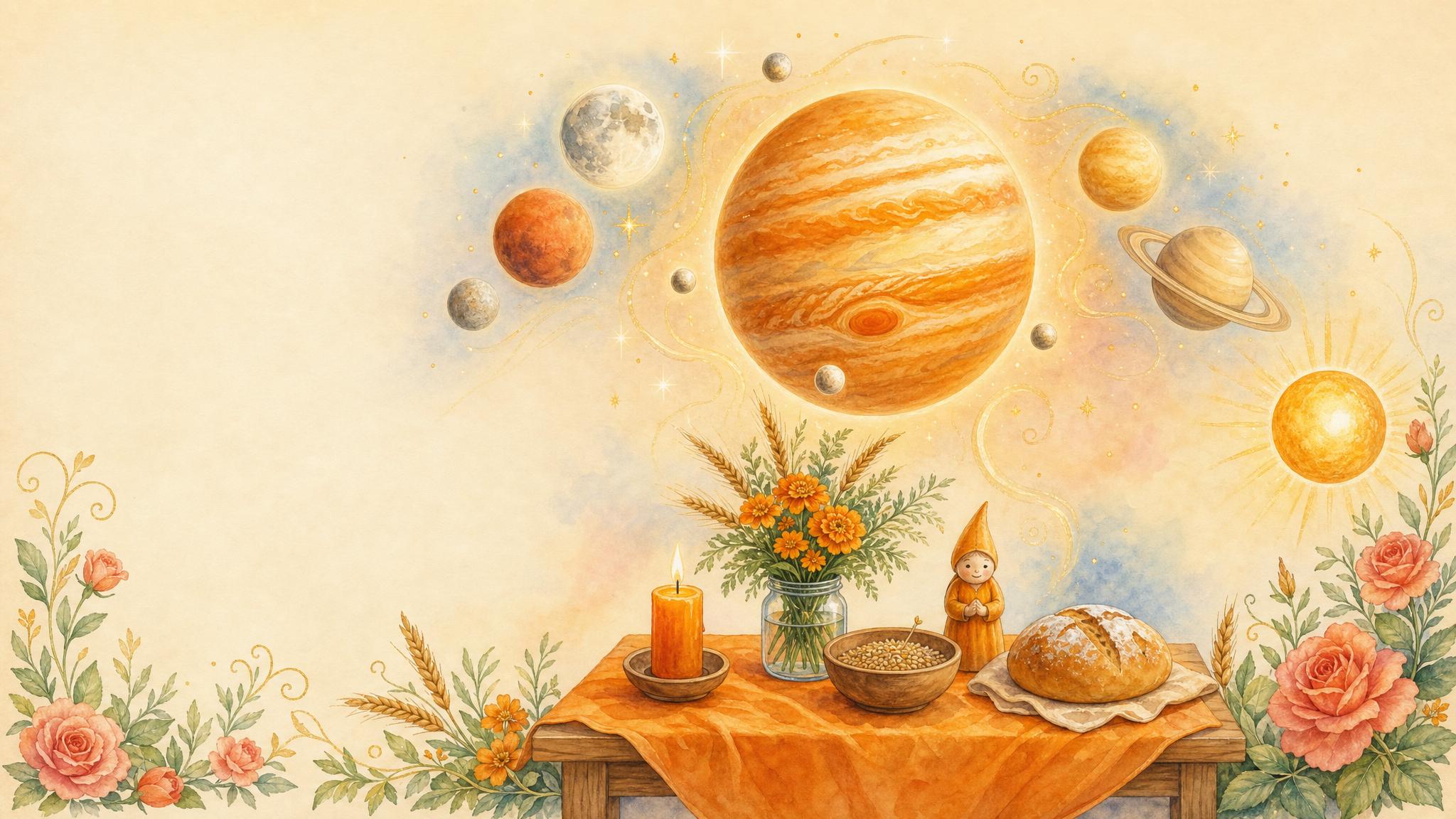
Watercolor Jupiter lesson hero with orange Jupiter, seven wandering lights, Thursday table, candle, herbs, seeds, and bread

Aim

To let the child meet Jupiter as the great generous planet of Thursday: wide, warm, wise, abundant, protective, and fair.

For young children, Jupiter is not a list of facts first. Jupiter is a feeling: arms open, table full, judgment kind, strength used for goodness. The facts come inside that picture.

By age

Littles (3–6): orange cloth, morning verse, four big moons, generous table work, and one Jupiter painting are enough. Keep it warm and embodied.

Olders (7+): add the Jupiter symbol, the Roman/Greek name, the number of known moons, the four Galilean moons, the Great Red Spot, and a short copied sentence in the main lesson book.

Materials

  • Orange cloth, silk, candle, or napkin
  • Orange, gold, ochre, rust, cream, and brown watercolor or crayons
  • One large ball or wooden circle for Jupiter
  • Four smaller stones, beads, or wooden balls for Io, Europa, Ganymede, and Callisto
  • Optional: many small seeds or beans to show Jupiter's many moons
  • Paper for the Jupiter symbol and main lesson book page
  • A bowl, basket, or tray for the generosity work
  • Seeds, herbs, oranges, carrots, squash, lentils, bread, or anything warm and plentiful for the table

Opening Verse

Orange morning, wide and bright,
Jupiter brings generous light.
Wise hands gather, kind hearts grow,
Plenty shared is plenty known.

Set Thursday

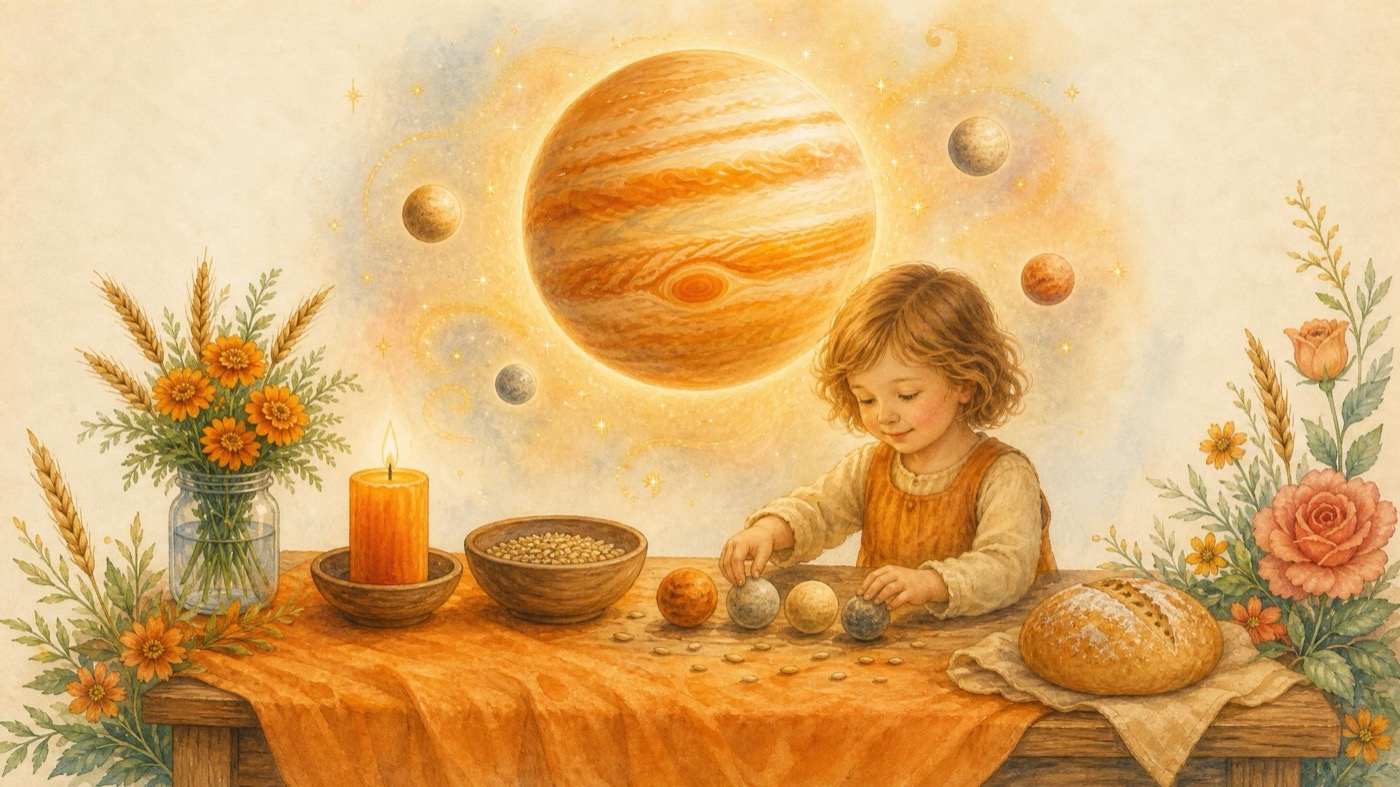
Lay the orange cloth first. Put the large Jupiter ball or circle in the center. Place four small moons near it, then scatter a few seeds farther out to show that Jupiter has many smaller moons beyond the four famous ones.

Say:

Today is Thursday. Thursday belongs to Jupiter. Its color is orange. Today we practice wisdom, gratitude, and generosity.

The Jupiter Picture

Jupiter is the largest planet in our solar system. It is so large that more than 1,300 Earths could fit inside it. It is made mostly of gas and cloud, and its bands look like cream, gold, brown, and orange ribbons wrapped around a great spinning world.

Jupiter has a storm called the Great Red Spot. It is a huge turning storm that has lasted for hundreds of years. For a child, call it the great red eye or the old red storm on Jupiter's cloak.

Jupiter has 95 officially recognized moons. NASA explains that Jupiter's moon count is sometimes described as between 80 and 95 because the Jovian system is complex, but the current official number used for a lesson is 95.

The Four Great Moons

The four famous moons were first seen by Galileo in 1610. They are called the Galilean moons.

Io is fiery and volcanic. It is the restless one.

Europa is bright and icy. Under her ice, scientists think there may be a deep ocean.

Ganymede is the largest moon in the whole solar system, even larger than the planet Mercury.

Callisto is old, dark, and cratered, like a memory-stone from the beginning of things.

For littles, say: Jupiter has four great moon-children we can name, and many smaller moon-children farther out.

Why Thursday Belongs To Jupiter

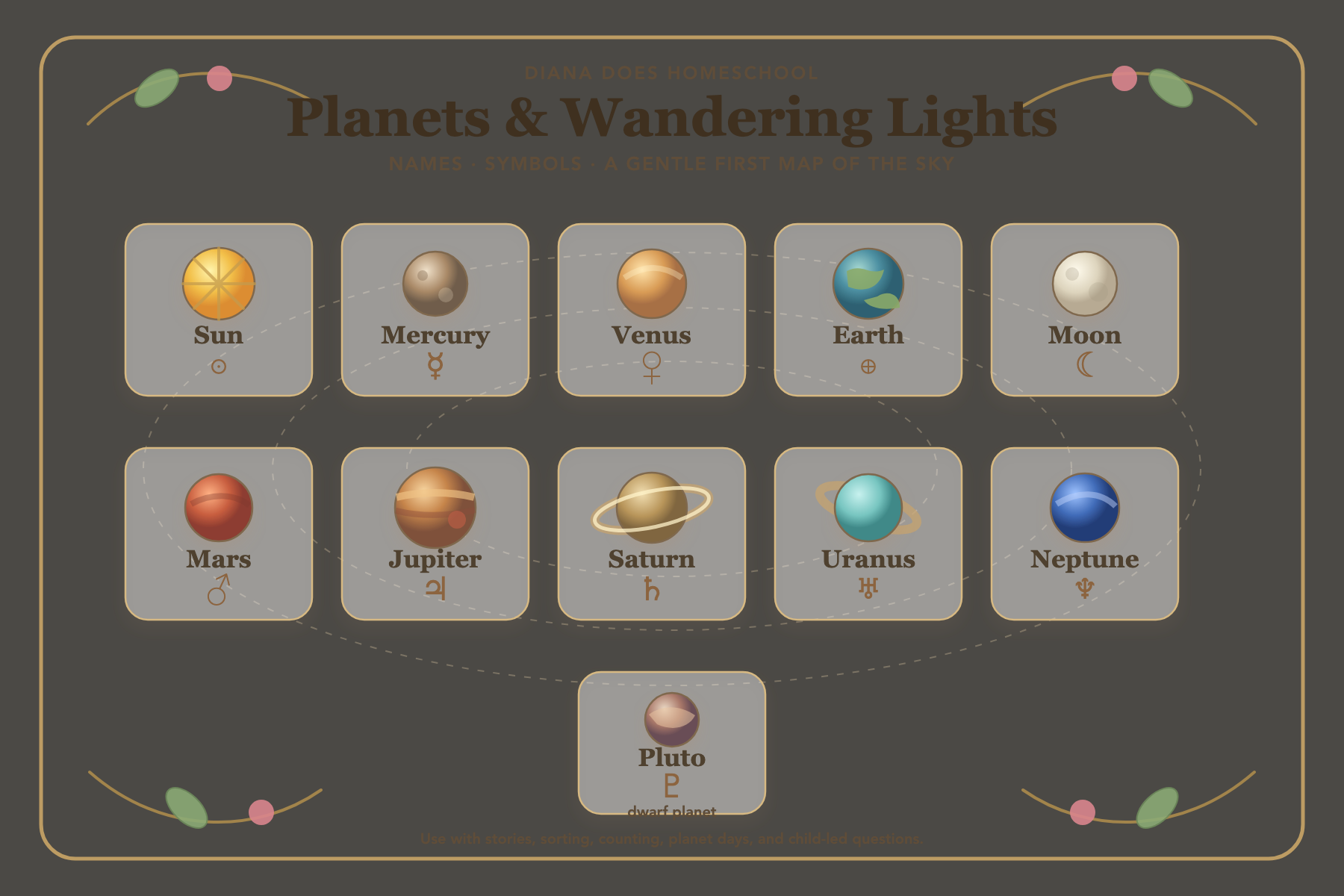
The old seven-day week comes from the seven wandering lights people could see in the sky: Moon, Mars, Mercury, Jupiter, Venus, Saturn, and Sun. Each light was given a day.

In Latin, Thursday was dies Jovis, the day of Jove, another name for Jupiter. In the old Germanic languages, that same day became Thor's day, because Thor carried a similar sky-thunder strength. That is why English says Thursday, but the older planetary meaning is still Jupiter day.

So Thursday carries a Jupiter mood even when the English name remembers Thor: wide sky, thunder-strength, wise rule, justice, blessing, and abundance.

Why Orange

In the family rhythm, orange is Thursday because orange feels like Jupiter: warm, full, outward, generous, and glowing without being sharp. It is the color of harvest food, autumn fruit, candle warmth, squash, carrots, marigolds, and a table that has enough to share.

Orange stands between red action and yellow light. That is exactly Jupiter's mood: strength warmed by wisdom. Not wild force, not quick cleverness, but mature abundance.

Say to the child: Orange is the color of a full bowl, a warm candle, and hands that share.

The Jupiter Symbol

Jupiter's symbol is written like this:

For children, draw it as a graceful curve beside a cross. The cross shows matter, earth, and the work of the world. The curved line rises beside it like spirit, wisdom, and generous breath. Jupiter means wisdom lifting ordinary life into blessing.

For older children, you can say the symbol is also connected to an old stylized sign for Zeus/Jupiter. Keep the main picture simple: the cross is the earthly task; the curve is the generous spirit that ennobles it.

Practice: draw the cross first. Then draw the curve like a kind arm opening beside it.

Story

Tell this slowly, moving the Jupiter circle and four moons as you speak:

Once there was a great orange king who lived in the wide sky.

He did not keep his table for himself. Around him moved many little lights, some near and some far, some quick and some slow. Four of them were great enough for children on Earth to learn by name.

First came fiery Io, dancing with sparks in her feet.

Then came Europa, wrapped in ice, carrying a secret ocean under her shining cloak.

Then came Ganymede, the largest moon-child, strong and bright, circling with steady steps.

Last came old Callisto, dark and cratered, keeping stories from long ago.

The great orange king watched over them all. His clouds turned in bands of cream and gold. His old red storm looked out across the dark.

One day, the moon-children asked, "What is the law of your kingdom?"

Jupiter answered, "What is given must be shared. What is strong must protect. What is wise must be kind. What is plentiful must feed the table."

So the moon-children carried the lesson around him, again and again, until even the people on Earth remembered it every Thursday.

Movement

Let one child stand as Jupiter in the center with arms wide. Four others, or four objects, circle as Io, Europa, Ganymede, and Callisto.

Say each moon's name as it moves. Io moves quick and fiery. Europa glides like ice. Ganymede takes large steady steps. Callisto moves slowly, like an old stone in the sky.

Then reverse the mood: Jupiter stands still, calm, and wide. The moons move around him. The child feels the difference between center and orbit, strength and motion.

Table Work

Build Jupiter with one large circle and four moons. Then count out 95 seeds or beans into a bowl if the child is old enough to enjoy the number. Do not force it for littles; four named moons are plenty.

Sort the seeds into groups of ten, with five left over. Say: Jupiter has ninety-five known moons. Four are famous. Many are small and far away.

Write or copy:

Jupiter is the great planet of Thursday. Its color is orange. It teaches wisdom, generosity, and abundance.

Watercolor Painting

Paint a large round Jupiter in orange, gold, ochre, cream, and brown. Let the colors move in bands. Add one red oval for the Great Red Spot.

On a second page, paint four small moons around a large orange circle. Name them under the painting: Io, Europa, Ganymede, Callisto.

Keep the painting warm and spacious. Jupiter should feel like a full harvest sky.

Practical Work

Choose one Thursday act of plenty:

  • Make a gratitude bowl with orange fruit, carrots, squash, or bread
  • Set the table with one extra beautiful thing
  • Share food with someone before serving yourself
  • Water herbs or gather something from the garden
  • Make soup, muffins, lentils, or roasted vegetables
  • Say one fair sentence: "You may have a turn, and then I will have a turn."

Jupiter is learned through generous action. The child should do something real with their hands.

Spiritual Meaning

For the parent:

Jupiter is the mood of benevolent authority: strength that protects, wisdom that blesses, abundance that feeds, and order that makes room for everyone. Thursday can train a child to feel leadership as service, not domination.

For the child, keep it simple:

Jupiter is big and bright. Jupiter has many moons. Jupiter teaches us to share what we have, use strength kindly, and make the table wide enough for others.

Closing Blessing

Jupiter wide, Jupiter bright,
Guard the table, warm the light.
May our plenty overflow,
May our wiser kindness grow.

Parent Note

This lesson should not become a lecture. Give the child the orange cloth, the great planet, the four moons, the generous table, and the feeling of wide kindness. Add the moon count, symbol, and day-name history for older children as they are ready.

Thursday is not just "Jupiter facts." Thursday is Jupiter practiced.